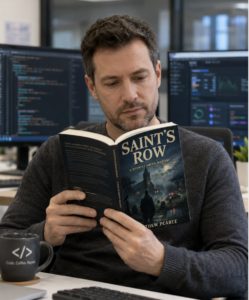
Mystery readers love a good twist, but IT professionals are built a little differently. They do not just enjoy the reveal. They enjoy the process. They notice the strange detail that should not be there, the pattern buried inside the noise, the missing piece that changes everything, and the hidden system running underneath the obvious one. That is exactly why Saint’s Row by Matthew Pearce stands out as the kind of murder mystery novel that feels tailor-made for people who spend their lives solving problems other people overlook. 🕵️♂️
At first glance, Saint’s Row has all the pieces a gripping murder mystery needs: a ritual killing, a closed-off town, buried secrets, religious symbolism, rising tension, and an investigator trying to expose the truth before it disappears. But underneath the surface, the novel works like a corrupted system that has been running for generations. The deeper Mathias Green digs, the more he realizes the murder is not an isolated event. It is a symptom of something much larger.
That is where IT professionals will find themselves hooked. This is not just a story about finding a killer. It is a story about tracing failures back to their source, identifying hidden connections, uncovering falsified records, and realizing that the visible problem is rarely the whole problem. For readers who love investigative thinking, layered clues, and dark atmospheric storytelling, Saint’s Row deserves a place among the best murder mystery books.
A Mystery That Thinks Like a Troubleshooter
Every IT professional understands one painful truth: the first problem reported is usually not the real problem. A user says the software is broken, but the actual issue might be a permissions conflict, a bad update, a network failure, a misconfigured plugin, or a forgotten setting buried three menus deep. The obvious symptom is only the beginning.
Saint’s Row works the same way.
The novel begins with the brutal death of Pastor Gideon Vale, staged with horrifying precision inside a dying church. That murder should be the center of the investigation. Instead, it becomes the entry point into something far more disturbing. Investigator Mathias Green arrives in Saint’s Row, Louisiana, expecting to examine one death, but soon finds himself facing a town that seems designed to protect its own secrets.
For IT professionals, that setup feels familiar in a completely different context. They know what it means to walk into a system they did not build, inherit years of bad decisions, and slowly discover that everything is connected. One broken process leads to another. One strange error reveals a deeper weakness. One ignored warning becomes a major failure.
That is the engine that makes Saint’s Row so compelling. It rewards the reader who pays attention. It invites readers to think beyond the first answer and look for the structure underneath the chaos.
The Hidden System Behind the Crime
The most powerful mysteries are not just about who committed the crime. They are about how the crime was allowed to happen. That is one reason Saint’s Row fits so well for IT professionals, cybersecurity workers, analysts, developers, systems administrators, and anyone trained to investigate how systems fail.
In the real world of technology, professionals are constantly thinking about systems, vulnerabilities, access points, documentation, governance, and risk. Resources like the Cybersecurity and Infrastructure Security Agency emphasize the importance of identifying risks before they become destructive. In Saint’s Row, Mathias Green is doing a human version of that same kind of work. He is not patching software or scanning a network, but he is scanning a town full of silence, fear, and carefully protected lies.
The town itself operates like an old network no one has audited in decades. Every family seems tied to the same source. Every answer leads back to Saint Bartholomew’s Church. Every secret has been preserved by obedience, fear, and habit. The result is a mystery that feels bigger than one crime scene.
That gives the novel a sense of depth that many standard mysteries lack. The murder is not simply an event. It is evidence. It points to a long-running structure of control, trauma, hidden records, and institutional evil. IT professionals who enjoy root-cause analysis will recognize the shape of the story immediately. Mathias is not just asking who did it. He is asking how the whole thing stayed hidden for so long.
Why Detail-Oriented Readers Will Stay Locked In
IT professionals are often trained to notice what others skip. A tiny inconsistency in a log file can matter. A timestamp can change the whole story. A missing record can be more important than a complete one. Small details often reveal the truth before anyone is ready to admit it.
That kind of attention matters in Saint’s Row.
The book’s atmosphere is dark, Southern Gothic, and psychologically intense. There are buried records, falsified deaths, secret confinement, church history, family silence, and a boy named Judah Mercy who survived more than anyone should. Nothing in the story feels random. The clues do not simply decorate the plot. They build pressure.
This is the type of murder mystery that respects smart readers. It does not depend only on shock. It depends on accumulation. Piece by piece, Mathias uncovers the system beneath the surface. The more he learns, the more dangerous the truth becomes.
That makes the reading experience especially satisfying for professionals who enjoy investigation, logic, and discovery. It is the same mental satisfaction that comes from finally solving a stubborn technical issue after everyone else has given up. The answer was there the whole time. It was just buried under assumptions.
A Story About Records, Silence, and What Gets Covered Up
One of the strongest connections between Saint’s Row and the IT world is the importance of records. In technology, records matter. Logs matter. Documentation matters. Backups matter. Audit trails matter. When something goes wrong, the truth is often found in what was recorded, deleted, altered, or never documented in the first place.
That same idea runs through Saint’s Row.
Mathias discovers that the town’s horror is tied to hidden records, falsified deaths, and a long history of people protecting the institution instead of the innocent. That is what makes the novel more than a simple murder mystery. It becomes a story about information control.
Modern IT professionals live in an age where information security, data integrity, and responsible oversight matter more than ever. Reports like IBM’s Cost of a Data Breach Report 2025 show how costly failures can become when organizations lack proper controls, security, and governance. While Saint’s Row is fiction, its emotional power comes from a similar principle: when truth is hidden, people get hurt.
The novel turns that idea into a chilling story. The danger is not only in the killer. The danger is in the people who allowed the truth to stay buried. That gives the book a heavier emotional weight and makes Mathias Green’s investigation feel urgent, personal, and morally necessary.
The Perfect Mystery for People Who Think in Patterns
Many IT professionals are pattern thinkers. They can look at separate incidents and recognize a shared cause. They can see when a problem is repeating under different names. They understand that today’s emergency may be connected to last month’s ignored warning.
Saint’s Row is built for that kind of reader.
The town is filled with patterns: repeated silence, inherited trauma, religious language used as protection, families tied to old secrets, and a church that seems to sit at the center of everything. Mathias has to connect the pieces before the town destroys the evidence and the people who still carry the truth.
This type of storytelling works because it gives readers a reason to stay mentally engaged. The book is not just asking readers to watch events unfold. It is asking them to think, compare, remember, and suspect. That makes it especially appealing for IT professionals who already spend their days connecting clues and spotting what does not belong.
The broader technology world is also built around pattern recognition, especially as artificial intelligence, cybersecurity, and automation reshape the workplace. CompTIA’s IT Industry Outlook 2026 highlights major trends affecting technology and business strategy, including AI, skills development, and productivity. In a world where professionals are constantly learning to recognize new patterns, Saint’s Row offers a fictional investigation that scratches the same mental itch.
Why the Dark Atmosphere Works So Well
A great murder mystery needs more than clues. It needs mood. It needs tension. It needs a place that feels alive with danger. Saint’s Row delivers that through its Southern Gothic setting, storm-soaked pressure, decaying church imagery, and sense of a town rotting from the inside out.
The atmosphere matters because it mirrors the investigation. As storm waters rise and the town begins to come apart, the hidden truth rises with it. The setting does not feel like a background. It feels like part of the mystery.
For IT professionals, that may feel surprisingly familiar. Anyone who has worked through a major outage, breach, migration failure, or system collapse understands rising pressure. The clock is ticking. People are nervous. Every answer creates two more problems. Everyone wants the issue fixed, but not everyone wants to face what caused it.
That tension gives Saint’s Row its momentum. The danger is not clean or simple. It is layered, emotional, and deeply human. Mathias is not just solving a puzzle. He is moving through a town that has made silence part of its operating system.
A Murder Mystery With Cybersecurity-Level Suspicion
Good IT professionals are not paranoid, but they are cautious. They verify. They test. They look for the thing that does not match. They understand that trust without verification can become a weakness.
That mindset fits perfectly with Saint’s Row.
In the novel, the town closes ranks almost immediately. People know more than they say. The church has a hidden machinery of control. Records cannot simply be accepted at face value. The official story is not trustworthy. Mathias has to treat every answer like a possible misdirection.
This is part of what makes the book such a strong fit for readers who enjoy investigative complexity. It shares the same intellectual posture found in cybersecurity and IT risk management: assume there is more beneath the surface, verify the evidence, and follow the trail even when powerful people would rather keep it hidden.
The National Institute of Standards and Technology provides frameworks for managing cybersecurity risk, and while that belongs to the world of technology, the principle translates well into fiction. Risk hides in weak systems. Damage spreads when warning signs are ignored. Truth matters most when someone is trying to bury it.
That is the world of Saint’s Row.
Why IT Professionals Need Fiction Like This
IT work can be mentally exhausting. Professionals spend their days solving problems, managing systems, answering urgent requests, protecting data, learning new tools, and keeping businesses running. Sometimes the best escape is not a simple story. Sometimes the best escape is a different kind of problem to solve.
That is why murder mysteries are such a strong fit.
A well-written mystery gives the brain something enjoyable to chase. It offers clues instead of tickets, suspects instead of users, hidden motives instead of broken plugins, and a final reveal instead of another support escalation. For people who love solving problems, that kind of reading is relaxing without being boring.
The technology workforce continues to grow and change, with the U.S. Bureau of Labor Statistics tracking computer and information technology occupations as a major employment category. As more professionals spend their workdays inside complex systems, books like Saint’s Row provide a different kind of complexity: emotional, moral, atmospheric, and suspenseful.
It gives IT professionals a mystery worthy of their attention. It does not talk down to the reader. It trusts the reader to follow the trail.
A Book That Understands the Cost of Ignored Warnings
One of the most powerful themes in Saint’s Row is the cost of ignoring what should have been confronted long ago. The town’s secrets did not appear overnight. They were protected over time. People looked away. Records were hidden. Deaths were falsified. Children suffered. Faith language was twisted into a shield for cruelty.
That makes the story hit harder than a typical crime plot.
IT professionals understand ignored warnings. They know what happens when small problems are dismissed until they become catastrophic. They have seen outdated systems, weak passwords, missing backups, poor documentation, unpatched software, and leadership decisions that create preventable disasters. The context is different, but the lesson is familiar: hidden problems do not stay hidden forever.
The Wikipedia page on information technology describes the field broadly as involving computer systems, software, networks, and data. But anyone who works in IT knows the job is also about responsibility. It is about protecting what matters, keeping systems honest, and catching failures before they hurt people.
That is why Saint’s Row resonates. Mathias Green is doing more than solving a murder. He is exposing a system that should have been stopped years earlier.
Conclusion
Saint’s Row is the kind of murder mystery novel that gives IT professionals exactly what they love in a story: a visible problem with a hidden cause, a trail of buried evidence, a system built on secrecy, and an investigator sharp enough to see what everyone else missed.
It is dark, atmospheric, intelligent, and emotionally intense. It rewards careful attention. It turns records, silence, history, and institutional control into major pieces of the mystery. Most importantly, it understands that the truth is rarely sitting on the surface. It has to be found, verified, and brought into the light. 🔍
For IT professionals who spend their days solving complicated problems, Saint’s Row offers the perfect fictional escape. It is not just a murder mystery about one death in a dying church. It is a layered investigation into how evil hides inside systems, how silence protects it, and how one determined investigator can uncover what everyone else missed.